
Hurstville NSW 2220

Stock moved by lift between retail floors in Hurstville buildings

When a Hurstville tenancy occupies three levels, its stock travels vertically. Every carton goes into a lift, out onto a landing and along a corridor, and the soil from the dock is redistributed on every floor rather than staying at the bottom of the building.

In short

A vertical stock route spreads soil vertically. What arrives at a basement dock is carried into a lift car, deposited on landings and tracked along corridors at each level, so the areas needing attention are scattered through the building rather than concentrated near the receiving point.

Clean Best maps the full route at the walkthrough from Seven Hills and names each element: dock, lift lobby, car floor and threshold, landing, corridor and the stockroom at each level. Each gets a frequency reflecting the traffic it carries, which is usually higher near the lift than anywhere else on the floor.

The lift car and its thresholds carry everything

A goods lift car is a small floor that receives every wheel and every boot on the route. Its floor, its thresholds and the strip of landing either side take a concentration of traffic out of all proportion to their area, and they are also what anyone waiting for the lift looks at. Those few square metres repay attention more than almost any other surface in the building.

Scoping them explicitly, rather than leaving them inside a general reference to lift lobbies, is what gets them done. The car floor, the door tracks at the car and at each landing, and the threshold plates all need naming. Door tracks in particular collect grit that affects how the doors run, and cleaning them is straightforward provided nothing is adjusted or lubricated. Threshold plates in particular collect grit in the joint where the car meets the landing.
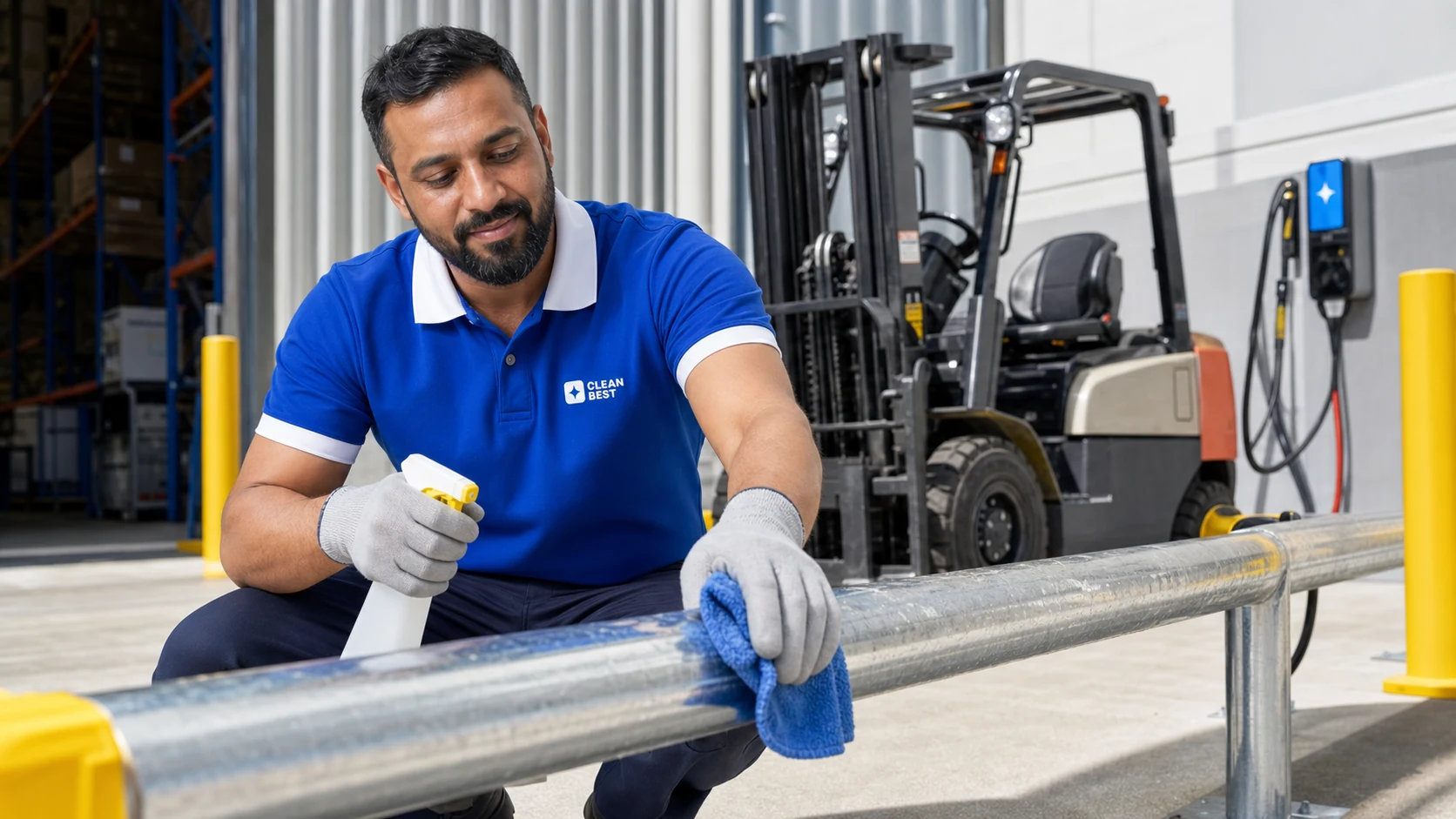
Landings behave like miniature docks

Where a lift opens onto a landing, that landing becomes a staging area. Cartons are set down while the lift is called back, cages wait, and material accumulates against the wall. It has the traffic profile of a dock in an area the building probably regards as a corridor, which is why it is usually under-scoped. Cartons left standing also mean the wall behind them is never reached.

Treating each landing as its own item with a frequency matched to the goods traffic, rather than to the pedestrian traffic on that floor, produces a better result for very little extra time. The walls at those landings also take cage contact, so the corner and skirting treatment used in a service corridor applies here too rather than an office finish. Where a landing is shared with a fire stair door, keeping it clear matters for more than appearance.

Stockrooms on separate levels are separate rooms

It is tempting to write one line covering the tenancy's storage across three floors, but the rooms rarely behave alike. The one nearest the lift takes the bulk deliveries and the traffic. Upper rooms may hold slower stock and need far less. A single frequency across all of them over-services one and under-services another. Seasonal stock can also shift the balance between them twice a year.

Listing them individually, with the level and a short description, lets each carry the interval it needs and makes the proposal readable. It also means a change on one floor, such as a fit-out or a change of use, can be handled without rewriting the storage arrangement for the whole tenancy. That flexibility matters in retail where floor use changes regularly. It also makes it obvious which room is absorbing the traffic and therefore the cost.

Vertical route items to map in Hurstville

  • Full route recorded from dock to each level's stockroom
  • Lift car floor, thresholds and door tracks named individually
  • Landings scoped against goods traffic rather than pedestrian traffic
  • Landing walls, corners and skirtings included
  • Each level's stockroom listed separately with its own interval
  • Door track cleaning included but adjustment and lubrication excluded
Clean Best supervisor checking a cleaned warehouse floor in Wetherill Park NSW

Working in Hurstville and the St George

Hurstville in the St George area combines offices, shopping centres, healthcare and high-density property, and its retail tenancies frequently occupy several levels of a building rather than a single floor plate. Stock consequently moves by lift rather than by trolley across a shop floor, which spreads the receiving soil through the whole building. Clean Best services Hurstville from Seven Hills and scopes the vertical route as a single sequence, since treating each floor independently misses the fact that they are all connected by one lift car.

Questions about Hurstville

Why does a lift car need its own frequency?

Because it is the one surface every item on the route crosses. Its floor takes wheel loads and boot soil from the dock all day, and it is also highly visible to anyone waiting for it. A few square metres attended more often does more for the appearance of a goods route than an additional pass across a whole corridor.

Are lift door tracks safe to clean?

Cleaning grit and debris from the visible track is routine and worthwhile, since accumulated material affects how doors run. What is excluded is anything mechanical: adjusting, lubricating, removing components or working inside the shaft. Lift pits, shafts and machine rooms are outside the scope entirely and are attended only by the lift contractor. Anything beyond the visible track is left to the lift contractor.

Should upper-level stockrooms be cleaned as often as the main one?

Usually not. The room nearest the lift takes the bulk of deliveries and the traffic, while upper rooms often hold slower-moving stock and generate far less. Listing them separately means each carries an appropriate interval, and a change on one floor can be handled without renegotiating the arrangement for the whole tenancy. The interval should be reviewed once the pattern of deliveries is established.

Who is responsible for the landing outside a tenancy?

It depends on how the building is held and should be established at the walkthrough. In many buildings landings are common area maintained by the owner's contractor. Where a tenancy's goods traffic is the main user, the tenant sometimes takes it on. Either way it needs a stated owner, since a landing left to two parties is cleaned by neither.

Can cleaning happen while stock is being moved?

Not in the same lift or on the same landing at the same time, since both are narrow and a cage has little room to pass. The practical arrangement is to attend outside the tenancy's receiving hours, which the store can usually describe precisely. Where that is not possible, the crew works the levels not in use and returns to the rest.

Get a fixed written quote for Hurstville

Free walkthrough, scope in writing, price back within 24 hours.

Request a quote
Call nowEmail us