
Barangaroo NSW 2000

Basement dock staging areas in Barangaroo towers and hospitality venues

A basement dock under a Barangaroo tower is a warehouse that happens to sit beneath premium offices. Goods land, stage, split and move on, and the only time its floor is genuinely available is the gap between two booked vehicle slots.

In short

Cleaning a Barangaroo basement dock and its staging area is a scheduling problem before it is a method problem. The dock runs to a booking system, the staging bays fill and empty through the day, and the cleaning attendance has to be granted a slot in the same way a delivery vehicle is.

Clean Best asks for that slot in writing rather than assuming a quiet period exists. The proposal names the staging bays included, the pedestrian routes across the dock, the waste and consolidation areas, and the times the building has confirmed. Crews attend from Seven Hills and work to the building's dock rules like any other contractor.

A booked dock is a precondition, not a courtesy

Docks under commercial towers are managed because they have to be. Vehicle heights, turning space and lift capacity all constrain what can happen at once, and an unbooked contractor standing in a bay with equipment is an obstruction rather than a service. Treating the cleaning attendance as something that fits around everything else is how the dock floor ends up permanently half done. It also puts the crew in the same queue as everyone else, which is exactly where a contractor should be.

The scope should therefore record the booking process itself: who holds the dock diary, how far ahead a slot must be requested, and what the standing arrangement is for recurring attendances. Where the building will only release the dock at a particular hour, that hour becomes the schedule. It is far better to write that than to price a service against a window that does not exist.
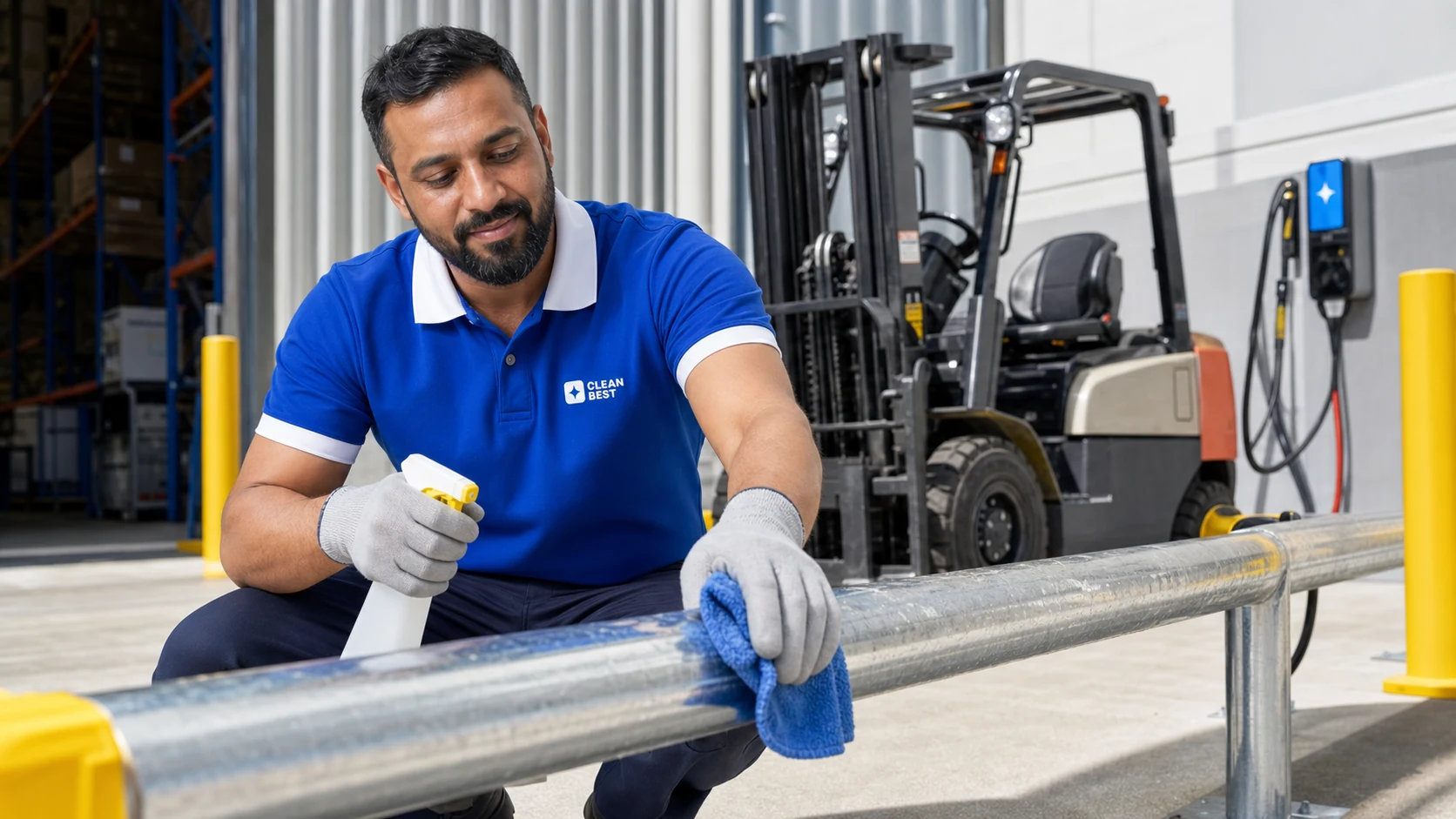
Staging bays behave like a warehouse floor

The staging area is where pallets are broken down, cages are loaded for individual tenancies and packaging accumulates. It carries wheeled traffic constantly, and the soil is a mixture of street grit from vehicle tyres, wrap and strapping fragments, and whatever leaks from a damaged carton. That is warehouse soil in a building that is otherwise cleaned to an office standard. Applying a tenancy specification to that floor produces a poor result and wears out equipment that was never intended for it.

It needs warehouse methods to match. A mechanical floor clean on an agreed cycle does more than repeated mopping, and the edges against the bay walls need their own attention because that is where wrap and dust collect. The office-standard equipment used upstairs has no place in this area, and the scope should keep the two separated in both method and consumables. Colour-coded equipment and a separate store for dock gear is the simplest way to hold that line.

Pedestrian routes across a working dock

Staff, couriers and contractors cross a basement dock on foot while vehicles reverse and cages move. The marked walkways are the safest part of that arrangement and they are also the part most often left out of a scope, because they belong to neither the dock operator nor the tenancy cleaning contract in most people's minds. So the walkway is swept whenever somebody happens to notice it, which is not a schedule and cannot be audited by anyone.

Naming them settles it. Marked walkways, the approach to the goods lift lobby, the door thresholds and the lift lobby floor itself form a short list that takes little time and is noticed by everyone who uses the building's back of house. Where line marking has worn to the point of being unclear, that is reported to the building rather than treated as a cleaning matter.

Dock scope items to confirm in Barangaroo

  • Dock booking process, diary holder and lead time recorded
  • Confirmed attendance slot written into the schedule
  • Staging bays listed with a mechanical floor method
  • Bay edges and wall lines included as a separate item
  • Marked walkways, thresholds and goods lift lobby named
  • Worn line marking reported to the building, not treated as cleaning
Clean Best supervisor checking a cleaned warehouse floor in Wetherill Park NSW

Working in Barangaroo and the Sydney CBD

Barangaroo sits at the western edge of the Sydney CBD and is built around premium offices, hospitality venues and waterfront commercial towers, all of which are served from below. Everything those buildings consume arrives through a basement dock and moves up through goods lifts on a booked schedule, which makes the dock the busiest logistics space in the precinct and the least visible. Clean Best works Barangaroo from Seven Hills, and the walkthrough here is mostly about the dock diary rather than the floor, because access is what determines whether the scope can be delivered at all.

Questions about Barangaroo

Why does a dock clean need a booking at all?

Because the dock is a shared, controlled space with limited bays and constant vehicle movement. A cleaning crew and equipment occupying a bay without a slot blocks a delivery and creates a safety issue with reversing vehicles. Booking is how every other contractor uses the space, and treating cleaning as exempt is what leads to attendances being turned away at the boom gate.

Can the dock be cleaned overnight instead?

Sometimes, and it is usually the best option where the building permits it. Overnight access depends on security arrangements, lighting and whether the dock is used for early deliveries. The scope should record what the building actually allows rather than what would be convenient, and note who provides after-hours access so the arrangement does not rely on one person's availability.

Who is responsible for packaging left in the staging area?

Generally the party that generated it, which is usually the tenancy receiving the goods or the building's own dock staff. Cleaning covers the floor once material has been presented to the waste point. If collecting and presenting packaging is to sit with the cleaning contract, it needs to be a named task with a stated destination and time allowance.

Are the goods lifts included in the scope?

Lift car floors and thresholds can be included where the building agrees and access can be arranged, since they carry the same soil as the dock. Lift pits, shafts, machine rooms and anything requiring a lift technician are excluded outright. Those areas need isolation and licensed personnel, and they are not part of a cleaning service at any frequency.

What happens if a vehicle occupies the bay at the booked time?

The crew works the areas that remain accessible and records the exception rather than waiting or improvising around a reversing truck. That record matters, because a pattern of blocked slots is information the building needs in order to fix the booking arrangement. A single note is an inconvenience; a repeated one is evidence that the schedule needs changing.

Get a fixed written quote for Barangaroo

Free walkthrough, scope in writing, price back within 24 hours.

Request a quote
Call nowEmail us