
Artarmon NSW 2064

Parts store cleaning scope for Artarmon workshops and industrial units

A parts store is an index as much as a room. Every small bin on those Artarmon shelves has a location code attached to it, and a cleaner who moves one to reach the dust behind it has just created a problem far larger than the dust ever was.

In short

The cleaning scope for an Artarmon parts or spares store treats bin locations as fixed. Floors, gangways, the ends of runs and exposed frame surfaces are cleaned. Individual bins, drawers and small-parts trays are left exactly where they sit, because their position is the record of what is inside them and where it belongs.

Clean Best sets that rule at the walkthrough and states it in the written proposal, along with the storeman's contact for anything found loose on the floor. Attendance is arranged from Seven Hills around the counter and workshop hours, so the run is cleaned when nobody is picking against it.

Location codes are the reason nothing moves

In a small-parts store the value is not in any single item but in knowing where each item is. Bins are labelled to a shelf, a bay and a level, and a system somewhere holds that map. Shifting a bin two positions to the left costs nothing in a physical sense and costs a great deal the next time somebody picks against the record and finds the wrong part in their hand.

That makes the cleaning instruction unusually simple. Nothing on a shelf is lifted, slid or turned. Dust on frames and shelf faces is removed around what sits there. If a bin has been left on the floor or on a gangway, it is reported to the storeman rather than returned to a guessed position, since a wrong guess is worse than an obvious misplacement somebody can see.
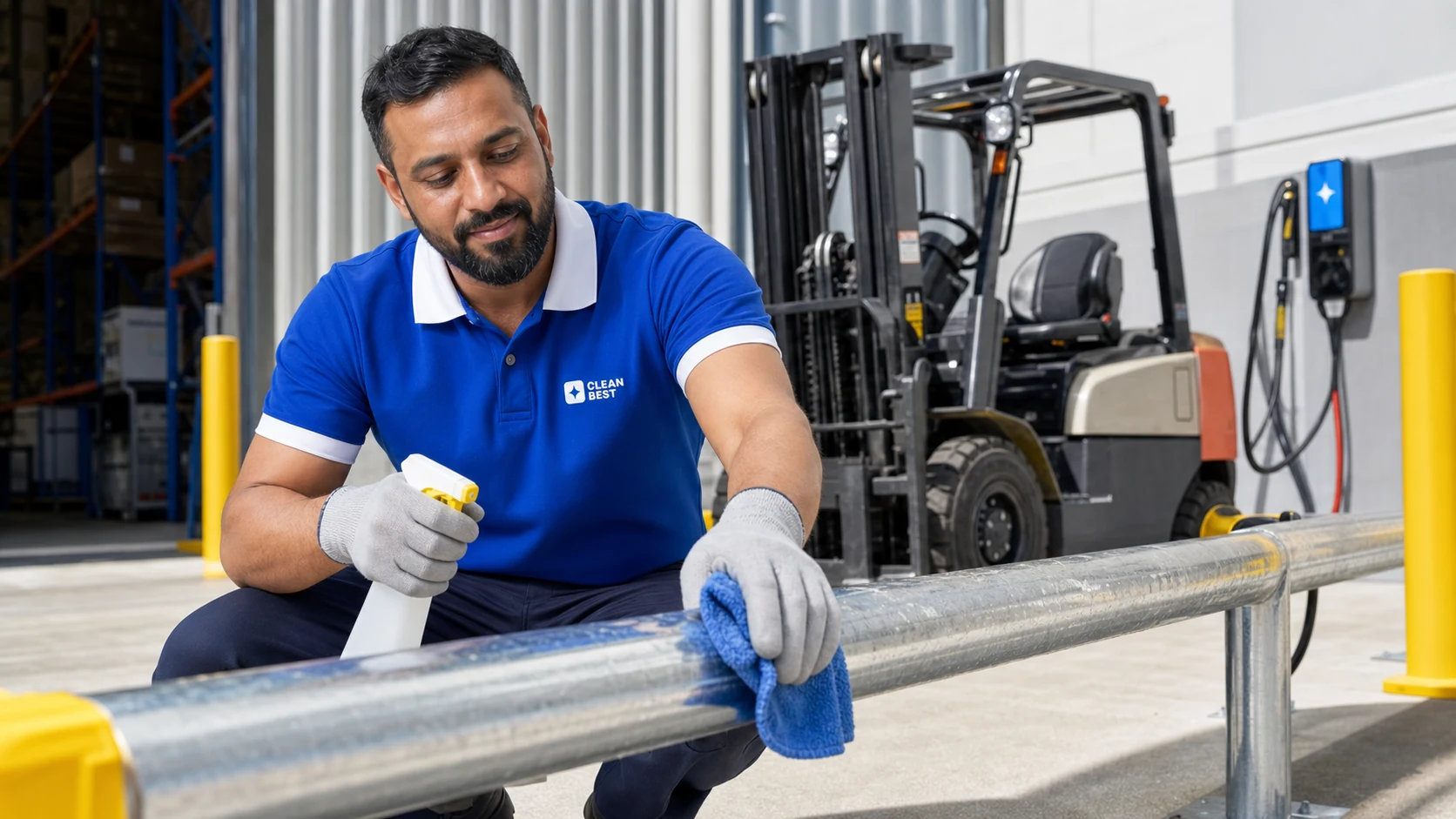
Floor soil in a store attached to a workshop

A parts store that opens onto a workshop receives a different soil profile from one that opens onto an office. Oil carried on boot soles, fine grinding residue drifting through a doorway, and rubber from trolley wheels all end up on the store floor, and they behave differently from ordinary dust. Dry sweeping alone can spread an oily film rather than remove it. The same is true of coolant or degreaser carried in on a trolley wheel, which spreads before it dries.

The proposal therefore records the store floor separately from the workshop floor, with its own method and its own product. Clean Best does not clean machinery, benches under work, or anything belonging to a production or repair process. The line sits at the store threshold, and drawing it there keeps two very different environments from being treated with one approach that suits neither. Where the doorway between the two stays open all day, that is noted too, because it changes how quickly the store floor loads up.

The counter, the office and the store as three areas

Many Artarmon industrial units run a trade counter at the front, an office beside it and the store behind. Customers see the first two, staff live in the third, and each has a different standard attached to it. Applying one frequency across all three either overspends on the store or leaves the counter looking tired, and neither outcome is what the operator asked for. Nobody is served by a single frequency chosen to average three different requirements.

Writing them as three lines lets the frequencies diverge sensibly. The counter and office can carry a presentation standard on a regular cycle. The store can carry a lower routine with a periodic deeper pass timed against a quiet week. The amenities keep a hygiene method of their own. One proposal, one contact, three clearly stated expectations. The storeman can then see what the store area is actually costing, and adjust that line alone if the trade pattern changes during the year.

Parts store rules to record in Artarmon

  • No bin, tray or drawer moved, lifted or turned for any reason
  • Frames, shelf faces and gangways included as cleaning surfaces
  • Items found loose on the floor reported to the storeman
  • Store floor method recorded separately from the workshop floor
  • Threshold to the workshop stated as the scope boundary
  • Counter, office and store frequencies listed as separate lines
Clean Best supervisor checking a cleaned warehouse floor in Wetherill Park NSW

Working in Artarmon and the Lower North Shore

Artarmon on the Lower North Shore holds industrial units, showrooms, offices and automotive businesses in a compact estate where the storage is often the deepest part of a narrow unit. Parts and spares stores here are usually tall, densely shelved and shared between a workshop and a trade counter, which is why the cleaning boundary matters more than the floor area suggests. Clean Best travels to Artarmon from Seven Hills and quotes after seeing the run in person, because the shelving arrangement in these units is rarely visible from a floor plan or a photograph.

Questions about Artarmon

Why can't a cleaner put a stray part back on the shelf?

Because a part in the wrong bin is harder to find than a part on the floor. Someone will eventually pick from that bin and receive the wrong item, and the error will not be traced back for weeks. Leaving it visible and reporting it to the storeman takes seconds and puts the decision with the person who holds the location record.

Can shelving be cleaned properly if nothing moves?

Frames, uprights, shelf faces and gangway edges can be cleaned thoroughly around fixed stock, and that covers most of what is visible. What cannot be done is cleaning the shelf surface beneath a bin. If that is wanted, the store nominates sections to be cleared in turn and those sections are cleaned when they are empty, as a scheduled item rather than an assumption.

How is oil tracked in from the workshop handled?

With a wet method and a product suited to it, applied to the store floor as a named task. Dry sweeping over an oily film spreads it and can make the surface less safe. Where oil is arriving continuously, matting at the threshold does more than extra cleaning. Recovering a floor that has absorbed oil over years is a separate question and is quoted separately.

Do you clean inside cabinets and parts drawers?

No. Drawers and cabinets hold inventory, and opening them puts a cleaner into the stock record. External surfaces, handles and the tops of cabinets are cleaned. If the inside of a unit needs attention, staff empty it and the clean is done while it is empty, which also gives the store a chance to check what is in there.

Can the store be cleaned while the counter is trading?

Usually yes, provided picking is not happening in the same run at the same time. The practical arrangement is to work the store outside peak counter hours and to move to another area if a picker needs the aisle. That is a simple courtesy rather than a safety issue, but it keeps the attendance productive and avoids anyone waiting on anyone else.

Get a fixed written quote for Artarmon

Free walkthrough, scope in writing, price back within 24 hours.

Request a quote
Call nowEmail us